Modelling infrastructure for the energy transition

Iris is a whole-of-economy energy and decarbonisation modelling platform. It models the energy system from household devices to the wholesale market in a single optimisation, so the plans it produces are plans the real system can run.

Built in Canberra by the team behind some of Australia's first virtual power plants, Dynamic Operating Envelopes and CSIP-AUS.

One model, five levels A layered network diagram. Devices connect to sites, sites to aggregators, aggregators to the distribution network, and the network to the market operator, all inside one Iris model. 5Market operator 5Market 4Network 4Network 3Aggregators 3Agents 2Sites 2Sites 1Devices 1Devices One Iris model
The five levels of a distributed energy system, from devices to the market operator, as set out in AEMO's 2025 Transition Plan for System Security. Iris studies how they interact in one model.

The energy system is changing faster than the models used to plan it

Electricity, gas, liquid fuels and transport are converging into one system. At the same time, rooftop solar, home batteries, virtual power plants, EV charging and electrification are reshaping the low-voltage grid.

Tools that model the network, the market and the customer separately can't show how these pieces interact. New modelling capability is needed to plan, build and operate the future energy system well.

507,000+
home batteries installed under the Cheaper Home Batteries program by August 2026
20 years
the scenario-based planning horizon now required of distribution networks in the National Electricity Market
$5 billion
what coordinating household energy resources could save by 2050, according to AEMO's 2026 Integrated System Plan

Uncoordinated management of distributed energy risks “substantial system integration costs, reduced system operability and material system security risks.”

AEMO, Transition Plan for System Security, 2025

Plan for operations

System plans have to account for how operating envelopes, tariffs and virtual power plants will actually behave.

Operate to plan

Operational technology has to perform the way the plan assumed it would.

Get it wrong one way and consumers pay for network they don't need. Get it wrong the other way and their solar and batteries are curtailed.

Sources: DCCEEW, reported by Energy-Storage.news (17 August 2026); AEMC final rule ERC0410 (16 July 2026); AEMO 2026 Integrated System Plan, cited by Energy Consumers Australia (June 2026); AEMO Transition Plan for System Security (December 2025), p.128.

Two design decisions make Iris different

Iris is a general-purpose, market-aware, spatio-temporal modelling platform. It handles questions from the market value of a single asset through to low-voltage and whole-system planning across electricity, gas, liquid fuels and transport.

Physics first

Energy balance, thermal and voltage limits, conversion efficiencies and every storage asset's state of charge over time are built into the model, not checked afterwards.

Every result is a state the real system can reach, so a plan can be built and operated as modelled.
An optimisation engine at the core

Iris solves for behaviour rather than taking it as an input. Every asset, from network assets to household batteries, EVs and virtual power plants, is a decision variable.

Planning and operational decisions are solved together, so forecast behaviour is realistic and the investments Iris identifies are optimal.

What the platform does

  • Fully nodal, bottom-up modelling
  • Electricity distribution and transmission, gas, liquid fuels and carbon in one model
  • Embedded optimisation of every asset
  • Optimal network investment decisions
  • Reconciliation with top-down forecasts
  • Adaptive temporal and spatial resolution over long horizons
  • Scenario and Monte Carlo analysis at scale
  • AI-assisted modelling workflow
  • Works with leading price and generation forecasts rather than replacing them

Open where it counts

The core Iris modelling engine will be released as open source, so networks, regulators and their advisers can inspect exactly how results are produced. The workflow, data and AI layers built around it are Iris products.

Inside Iris

A distribution planning study, from template to results.

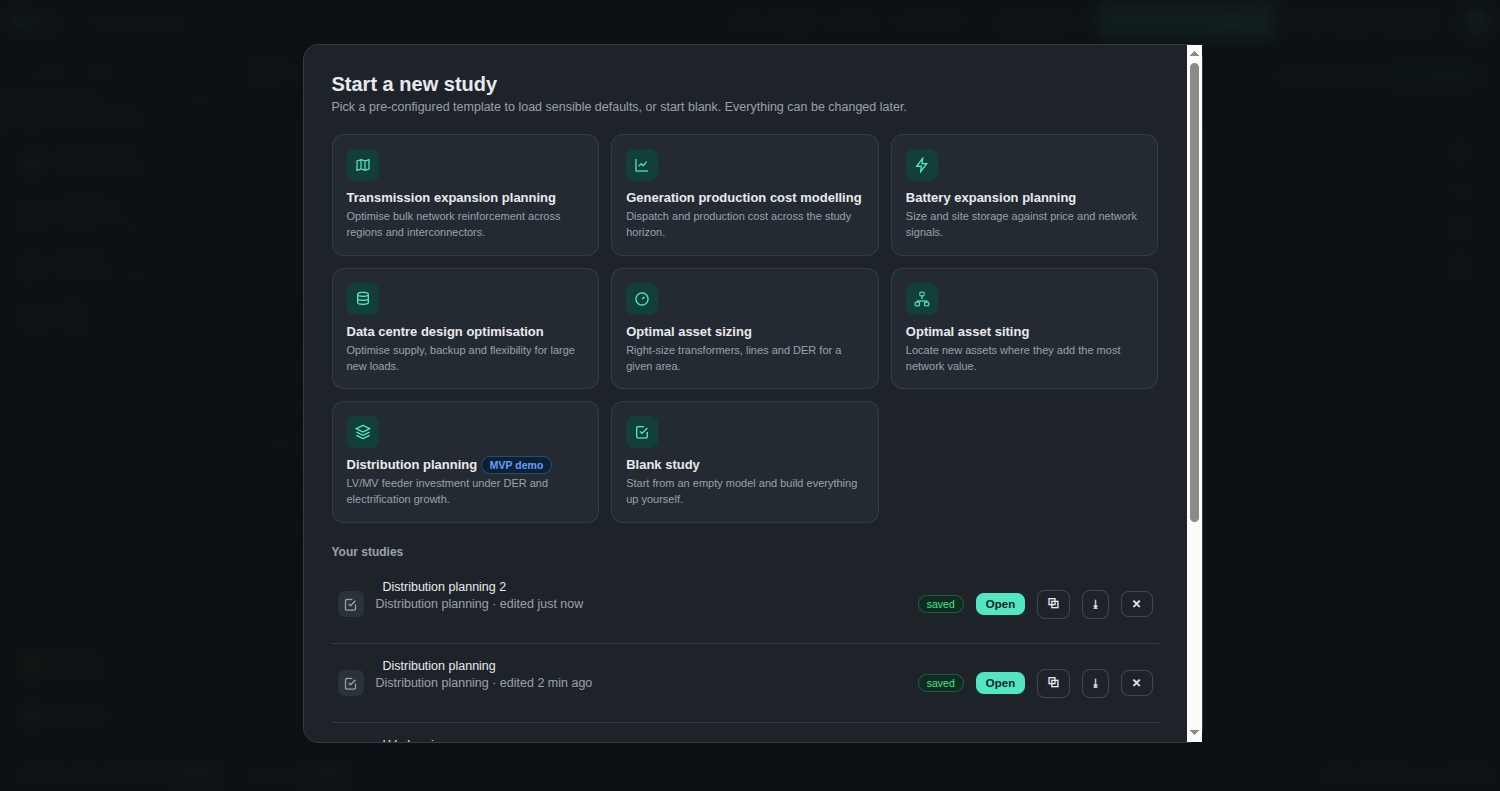
The Start a new study dialog, showing study templates and a list of saved studies
Start a studyPick a template, such as transmission expansion, battery siting or distribution planning, or start from a blank model.
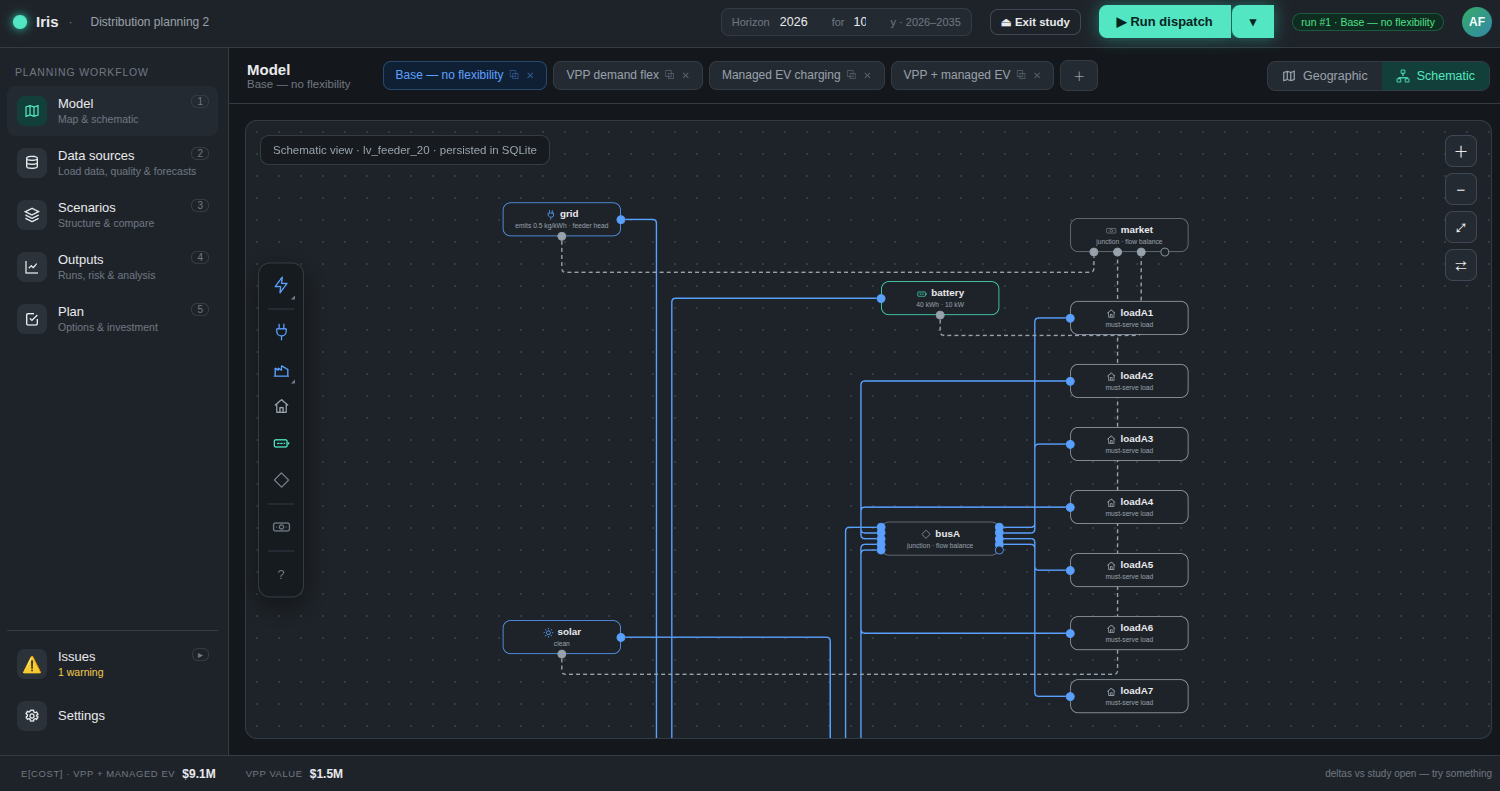
Schematic view of a low-voltage feeder with grid, solar, battery and household load nodes
Build the modelLay out the network in schematic or geographic view. Here, a low-voltage feeder with solar, a battery and household loads.
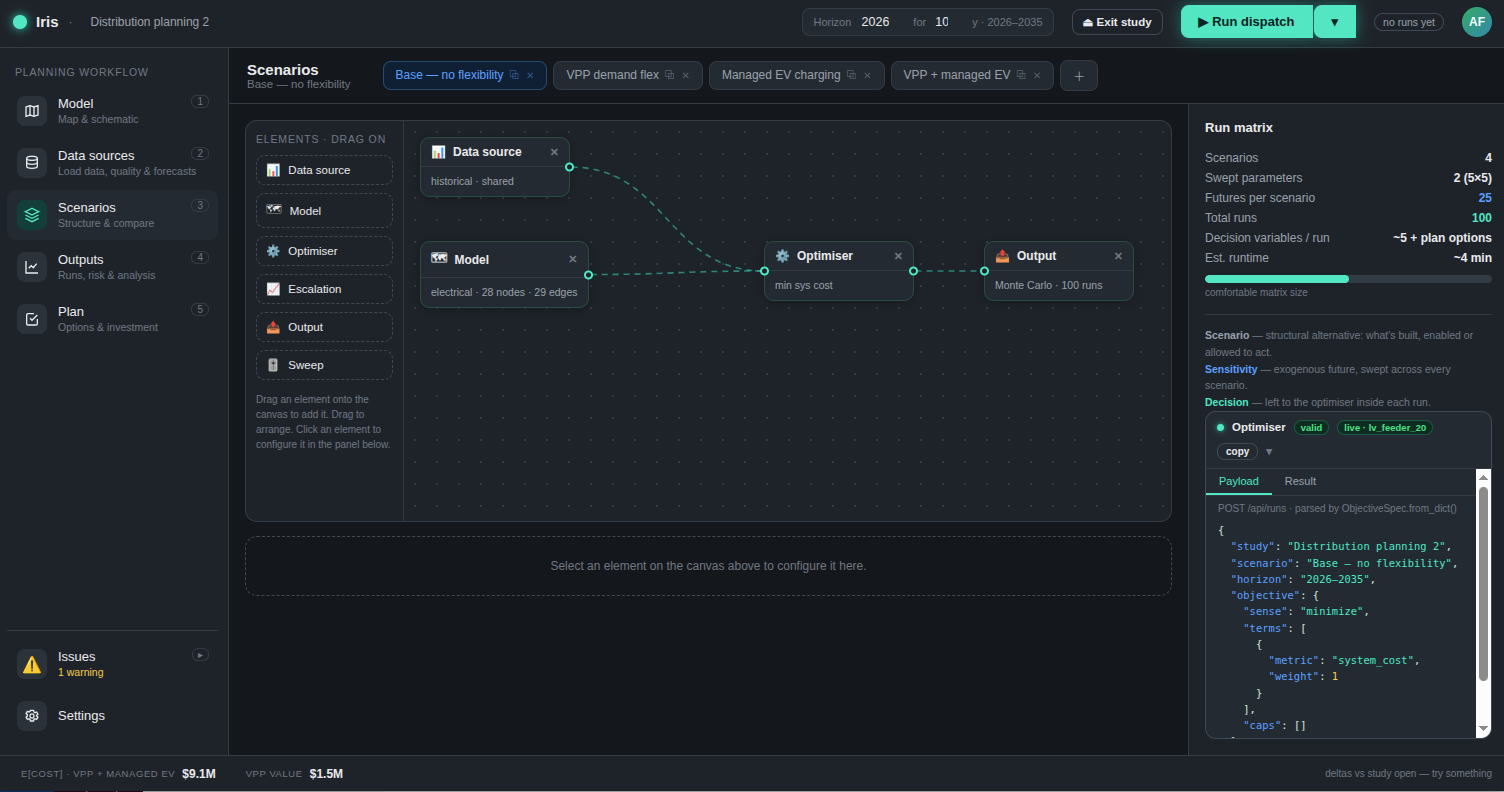
Scenario builder connecting a data source and model to the optimiser and a Monte Carlo output, with a run matrix summary
Define scenariosConnect data, model and optimiser, sweep the uncertain parameters, and see the size of the run matrix before you run it.
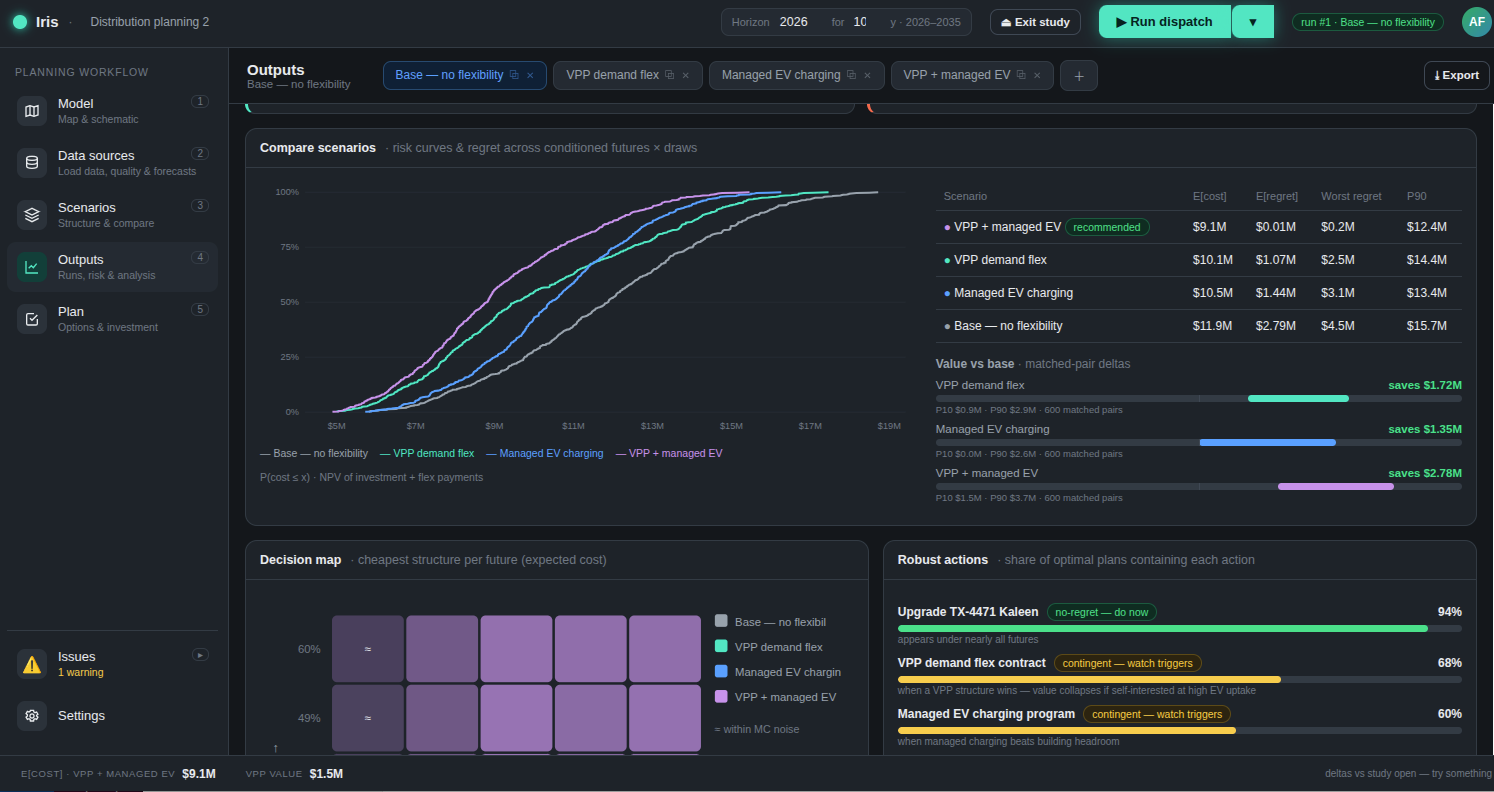
Outputs view comparing four scenarios with cost risk curves, regret, a decision map and robust actions
Compare outcomesRisk curves and regret across hundreds of futures show which plan holds up and which actions are no-regret.

One model, from devices to the market

AEMO's Transition Plan for System Security describes five levels for managing distributed energy. Each one makes decisions that change the others. Iris brings them into one coherent model, so the interactions between households, aggregators, networks and the bulk system can be studied together.

Levels as defined in AEMO's Transition Plan for System Security (December 2025), section 9.2.1.

  1. Market and system operator

    Wholesale prices, dispatch and system security

  2. Distribution network

    Network limits, tariffs and operating envelopes

  3. Customer agents

    Retailers, aggregators and virtual power plant operators

  4. Sites

    Homes and businesses, optimised at site level

  5. Devices

    Solar, batteries, EVs, heat pumps and hot water systems

What teams use Iris for

Distribution network planning

Low-voltage and network planning for the new 20-year, scenario-based distribution plans: hosting capacity, operating envelopes, tariffs and where to invest.

For distribution networks

Energy system transition planning

How devices, sites, aggregators, networks and the market interact across all five levels, and what that means for cost, security and emissions.

For market bodies and system operators

Virtual power plants and tariffs

Design virtual power plants and tariffs that work within network limits and respond to wholesale prices.

For retailers and aggregators

Assets, storage and precincts

The market value of individual assets, siting and sizing of storage, data centre connections and precinct decarbonisation.

For developers and asset owners

Decarbonisation and policy

Whole-of-economy questions across electricity, gas, liquid fuels and transport, such as how a carbon price flows through to household energy costs.

For governments, regulators and policy teams

A technology company, not a consultancy

Iris builds tools and capabilities for modelling teams. Through our Trusted Partner Program, advisory firms and consultants use Iris to deliver studies directly for their own clients.

We've done this before

Iris was founded by the people behind some of Australia's first virtual power plants, Dynamic Operating Envelopes and CSIP-AUS. All four founders work on Iris full-time.

Lachlan Blackhall

Co-founder. Energy systems, policy and regulation

Engineering PhD with more than 15 years across energy research, industry, policy and regulation. Co-founder and CTO of Reposit Power. Fellow of the Australian Academy of Technological Sciences and Engineering.

Andrew Fraser

Co-founder. Network innovation and commercial

Electrical engineer with more than 20 years in energy. Co-founder and CEO of Elentar, and five years as Leader of Innovation at TasNetworks.

Josh Vote

Co-founder. Software and network modelling

20 years building tools, standards and algorithms for grid-connected energy resources at CSIRO and in industry, including power flow and dynamic pricing.

Mitchell Blyth

Co-founder. Optimisation and forecasting

Software developer with a PhD in quantum chemistry and a background in large-scale energy forecasting and optimisation.

Track record

  • Built early virtual power plants at Reposit Power, including the ARENA-funded CONSORT project on Bruny Island
  • Defined and operationalised Dynamic Operating Envelopes through ARENA-funded projects
  • Led the CSIP-AUS specification, its reference implementations and the CACTUS test harness

Iris is part of EnergyLab's Climate Tech Charge program.

Advisory board

Lynne Gallagher
Board Member, Australian Energy Regulator. Former CEO, Energy Consumers Australia.
Liza Maimone
CEO, Fyfe. Former COO and Energy Transition Executive, PwC Australia.
Shane Rattenbury
Former ACT Attorney-General, Minister for Climate Change Mitigation and Leader of the ACT Greens, 2012–2026.

Talk to us

Tell us which part of the energy system you need to plan, and we'll show you what Iris can model.

Andrew Fraser
andrew@irissys.io
Lachlan Blackhall
lachlan@irissys.io
Location
Canberra, ACT, Australia